

A quick summary:
At the Lockton People Solutions Forum, we challenged a long-standing assumption in our industry: that offering more choice leads to better outcomes.
It doesn’t.
What we’ve actually built over time are benefit ecosystems that are rich in options but poor in relevance; they’re static, fragmented, and fundamentally out of sync with how people live. In a world where expectations are shaped by real-time, hyper-personalised digital experiences, across everything from media to travel, that gap is becoming impossible to ignore.
The next evolution of benefits won’t be driven by more choice. It will be driven by intelligence.
AI is turning personalisation into something dynamic, not static
For years, “personalisation” in benefits has meant light segmentation by age, life stage, or job role. But this is extremely reductive, assuming that people with the same demographic markers have the same needs, at the same time.
Consider a 35-year-old woman in your workforce. From a hormone health perspective alone, she may be a parent, trying to conceive, or entirely uninterested in starting a family. She may even be in the early stages of perimenopause, and seeking support there. Yet “personalised” femme care benefits will make assumptions demographically (e.g. working-mum) and make that visible to that employee.
AI changes that entirely.
Instead of segmenting employees, AI allows us to understand them as individuals in motion. It analyses patterns in behaviour, engagement, and usage to continuously adapt what support is surfaced, shifting in real time as needs evolve.
This is the difference between a platform that offers benefits and one that orchestrates them.
At Heka, we’re seeing how this kind of intelligence transforms engagement. When the system learns from how employees interact (what they use, when they disengage, what they ignore) it starts to refine the experience automatically. Benefits become less about browsing and more about receiving the right nudge, at the right moment.
Personalisation, in this context, isn’t a feature. It’s a whole new way of supporting people.
From reactive strategy to predictive ecosystems
One of the biggest limitations of traditional benefits design is that it’s backward-looking.
We analyse last year’s data, identify trends, and adjust accordingly. But by the time those insights are acted on, the workforce has already moved on, often literally if they’re not feeling supported at work.
AI flips this model from reactive to predictive.
By identifying early signals (changes in engagement, shifts in behaviour, emerging patterns across teams) AI anticipates needs before they fully materialise. That might mean recognising the early signs of burnout, identifying rising financial stress, or spotting disengagement before it turns into attrition.
The impact of this shift is profound.
Instead of waiting for employees to reach a point of need, organisations can intervene earlier, with more precision and less friction. Benefits stop being a safety net and start becoming an early-warning system.
Accessibility becomes frictionless when intelligence does the work
Accessibility has always been framed as a communications problem: how do we make benefits visible to more people?
But in reality, it’s an experience problem.
Employees don’t fail to engage because benefits aren’t available, they choose not to engage because accessing benefits requires effort, awareness, and decision-making at a moment when they often have neither the time nor the context. And more often than not, when the benefits aren’t truly relevant.
AI removes that burden.
By surfacing relevant support proactively, through intelligent recommendations, timely prompts, and simplified journeys, AI reduces the cognitive load on employees. It shifts the experience from “search and select” to “receive and act.”
Let’s take our 35-year-old employee again and assume she’s recently got into running. She’s set her health goal as ‘improve fitness’ and subscribed to a running coach app through her benefits. Rather than trawling through a static pdf or intranet to understand what else is available, AI tailors her benefit experience, surfacing everything she needs to thrive, from physiotherapy and supplements, to race events and complimentary exercises.
This is what true accessibility looks like: not just making benefits available, but making them inevitable.
Whether someone is desk-based or deskless, early in their career or deep into it, benefits must adapt to meet them where they are, without complexity.
A new formula, for a new era of benefits. Powered by new technology
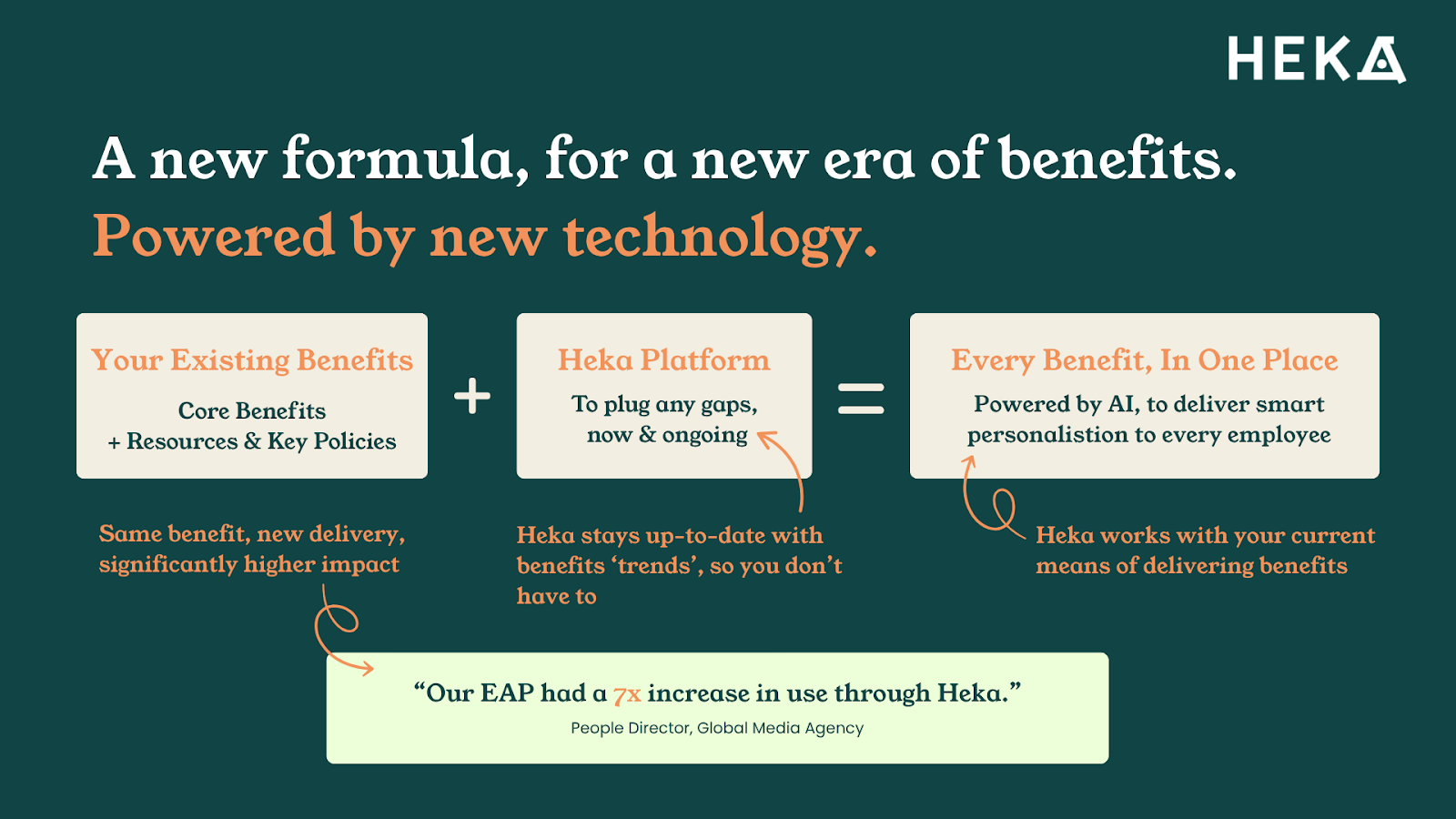
What we’re moving towards is something fundamentally different from the platforms of the past.
Not a marketplace. Not a menu. But an intelligent engine.
An engine that continuously learns, predicts, and optimises. One that connects disparate data points and translates them into meaningful, personalised action.
In this model, the value isn’t in the breadth of benefits offered. It’s in the precision with which they’re delivered.
And critically, it’s in the outcomes they drive.
Because when AI is applied effectively, we move beyond measuring clicks and logins. We start measuring impact: reduced absenteeism, improved wellbeing, stronger retention, and more sustainable performance.
The organisations that lead will think like technologists, not administrators
The conversation we started at Lockton’s People Solutions Forum is ultimately about mindset.
Benefits can no longer be treated as a static HR function. They must become a dynamic, data-driven system; one that requires the same level of strategic thinking we apply to customer experience or product design.
The organisations that get this right will be the ones that:
- Embrace AI not as an add-on, but as the core of their benefits strategy
- Shift from annual planning cycles to continuous optimisation
- Prioritise relevance and timing over volume and variety
- Design for outcomes, not just offerings
Because in a world where employees demand consumer-grade technology and platforms that anticipate their needs, the expectation is no longer that work will catch up.
It’s that it will lead.
The opportunity in front of us isn’t to iterate and add more ‘modern’ benefits. It’s build intelligent systems that understand people, evolve with them, and support them, often before they even know they need it.
That’s the promise of AI in this space. And Heka is already delivering on that promise.

.png)